Thursday, March 18, 2010

Types of Reactions.

1. Introduction/Background: In this lab, we will perform various chemical reactions. We will record our observations and then identify the types of reactions and balance each chemical equation. The lab purpose is to become more familiar with the 5 reaction types we use.


The 5 reaction types
:


2. Procedure:
A
.
First we got on all our safety gear(goggles and aprons)
B. Next we obtained 3 small test tubes from the lab kit & cleaned them out.
C. In the first test tube we placed one piece of zinc and about 1/2 ml of CuSo4 solution.
D. We observed the reaction and waited for around 5 mins.
E. In the second test tube we added 1/2 ml Ba(No3)2 solution to about 1/2 ml of CuSo4 solution.
F
.
In the third test tube we placed a pinch of magnesium, to 1/2 ml oh HCl solution.
G. We lit a Bunsen burner & observed the flame.
H.
Over the flame we put H2O2 and lightly heated it.
I. Then we added a pinch of MnO2(magnesium oxide).
J.
Then we observed the reactions that took place, and cleaned up the lab station.

3. Data Analysis:
Balanced equations (( 8===D O: ))
1. Zn + CuSO4 --> ZnSO4 + Cu
Single-Displacement Reaction

2. Ba(NO3)2 + CuSO4 --> BaSO4 + Cu(NO3)2
Double-Displacement Reaction

3. Mg + 2HCl --> MgCl2 + H2
Single-Displacement Reaction

4. C3H8 + 5O2 --> 3CO2 + 4H2O
Combustion Reaction

5. 2H2O2 --> 2H2O + O2
Decomposition Reaction


Friday, February 26, 2010

Polarity and Molecular Shape Lab

Title:
Polarity and Molecular Shapes Lab.


Statement of the Problem: How are molecular shapes determined?

Objectives: Construct models of molecules. Next, determine molecular shapes. Then, predict polarity of molecules.

Materials:
Molecular model kit, and lab sheet.


Procedure:
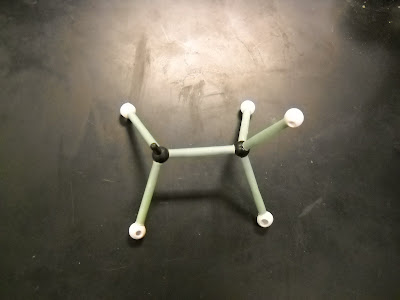
1.) The first thing we did was draw each Lewis structure for the following formulas: CH4, BF3, C3H8, H2O, Si2H6,HF, CH3NH2, H2O2, N2, SeF4, C2H4,SiH2O, IF3,SF6,CO2, and SO3(2-). 2.) Next, we constructed each 3-dimensional figur
e. 3.)We then drew each figure onto the lab sheet, We used solid lines to represent bonds, dashed lines to point back to the plane of the paper, and wedged lines for bonds that point out from the plane toward the viewers. 4.) Finally we looked on our other lewis structure papers to find the shape, bond angle, and polarity & resonance of each structure.

Analysis:

1) Explain how water shape causes it to have polarity. 2) Describe how water’s properties would be different if the molecules were linear instead of bent. 3) Based on the results of this experiment, list the molecules from the experiment that would be water-soluble.

Results:


Thursday, February 4, 2010

Lab Report Period 3 Group 11


Title:
Paper Chromatography Lab

Statement of the problem:
What is the mobile phase on a paper chromatography investigation?
What is the stationary phase in a paper chromatography investigation?
What is meant by the term retention time?
Paper chromatography is an important separation technique that depends on difference in both absorption and solubility.


Hypothesis:
Our hypothesis was H2O. It would be best because it has polarity and water is good.


Materials:
The materials that we used included: 9 strips of chromatography paper, H2O, CH3OH, C3H7OH, C6H14, 24 well plate,water-soluble overhead pens(black, red, green,brown,purple,yellow,blue).


Safety:
We used goggles and aprons. We stayed out of the fumes, and the fume hood. We put the chemicals under the fume hood. We used all of the safety precautions on this lab, and followed the directions.


Procedure:
First, we got on our safety equipment, then we got all of our materials together. Next, we filled up the 24 well plate with H2O, CH3OH, C3H7OH, and C6H14. Then we marked our paper strips with black marker. After that, we put the dots on the piece if paper and put it in the liquids and watched it rise. Our group let the paper sit in the liquids for approximately 30 minutes. We used the different colors to see which one of them would rise the most. After we wrote down all of our data, and finished the lab, we cleaned up and dumped the stuff out and finished the lab procedure.


Results:
During our lab, we figured out that H2O would rise the most with the black. We tried to use the other colors to compare them to the black. The liquid that rose the least was C6H14 because, the polarity is low.

Conclusion:
In conclusion, we found out that H2O was most polar, and rose up the paper quicker than the other solutions.